SpaceM Whitepaper - SpaceM

SpaceM WhitePaper

The Official SpaceM

Gain deep insights into our technology, token utility, roadmap, and how you can participate in the SpaceM journey.


spacem logo white

Participation Infrastructure for the Real World Economy

Whitepaper 2.0
Fixed Supply. Finite Emission. Community Governed.

Disclaimer

This document is provided for informational purposes only and does not constitute financial, legal, tax, or investment advice. Nothing contained herein should be interpreted as a solicitation to purchase or sell any financial instrument.

SPCM (SpaceM World Token) does not represent equity, ownership, debt, dividend rights, revenue share, or any form of financial instrument claim. Participation in the SpaceM ecosystem involves operational, governance, market, technical, and regulatory risk.

No statement in this document constitutes a guarantee of returns, capital preservation, or appreciation. All protocol mechanics are subject to smart contract enforcement and governance parameters.

Readers are encouraged to conduct independent research and consult qualified advisors before participating.

Forward-Looking Statements

This document contains forward-looking statements regarding the SpaceM ecosystem, including projected development timelines, governance transitions, and potential infrastructure evolution. These statements are subject to risks and uncertainties. Actual outcomes may differ materially. No reliance should be placed on forward-looking statements as representations of future fact.

Jurisdictional Notice

This document does not constitute an offer, solicitation, or invitation to purchase SPCM in any jurisdiction where such activity is prohibited or restricted. Persons accessing this document are responsible for compliance with the laws applicable to them. This document is not directed at persons in the United States, or in any jurisdiction where the distribution or use of this document would be contrary to applicable law.

1. Executive Summary

SpaceM introduces a Real-World Digitalization (RWD) framework implemented through a RWD Participation Protocol designed to coordinate structured blockchain participation with real-world economic activity without tokenizing ownership and without relying on perpetual token inflation.
The protocol is constructed around five structural principles:
Unlike inflation-driven ecosystems that require continuous emissions to maintain engagement, SpaceM implements a finite bootstrapping distribution phase that concludes permanently on 09 May 2029. After this date, no further scheduled emissions occur and no new minting is possible.

SPCM functions strictly as a participation and coordination token. It does not represent equity, debt, or financial claims. Its role is infrastructural — enabling alignment, governance participation, locking mechanics, and ecosystem access.

The long-term objective is to transition from emission-supported distribution into a utility-driven participation infrastructure where supply can only remain constant or decrease.

SpaceM does not tokenize ownership.
It digitizes participation.

As the ecosystem evolves, SpaceM progresses from a functional infrastructure layer into a coordination network integrating real-world partners and economic activity. Over time, the protocol may extend into a dedicated blockchain or settlement environment and expand beyond internal use toward broader external integration.

At maturity, this progression may align with institutional-grade infrastructure, enabling the protocol to extend beyond a single ecosystem toward adoption as a coordination infrastructure for real-world digitalization.

2. Structural Problem Statement

2.1 Inflation Dependency in Blockchain Ecosystems

Many blockchain ecosystems rely on inflationary token emissions to incentivize participation. While effective in early growth phases, such systems frequently encounter structural fragility once emissions decline.

Common weaknesses include:
When engagement is primarily emission-driven, sustainability often diminishes as token issuance decreases.

2.2 Asset Tokenization Limitations

Real-World Asset (RWA) tokenization digitizes ownership or financial claims in physical assets. While valuable in certain contexts, RWA structures introduce: Ownership tokenization does not inherently improve coordination infrastructure.

2.3 Participation Infrastructure as an Alternative

Blockchain systems excel at coordination but often lack structured participation infrastructure that links digital networks with real-world economic activity without transferring ownership.

SpaceM introduces Real-World Participation as a structural alternative — digitizing coordination rather than ownership.

3. Protocol Overview

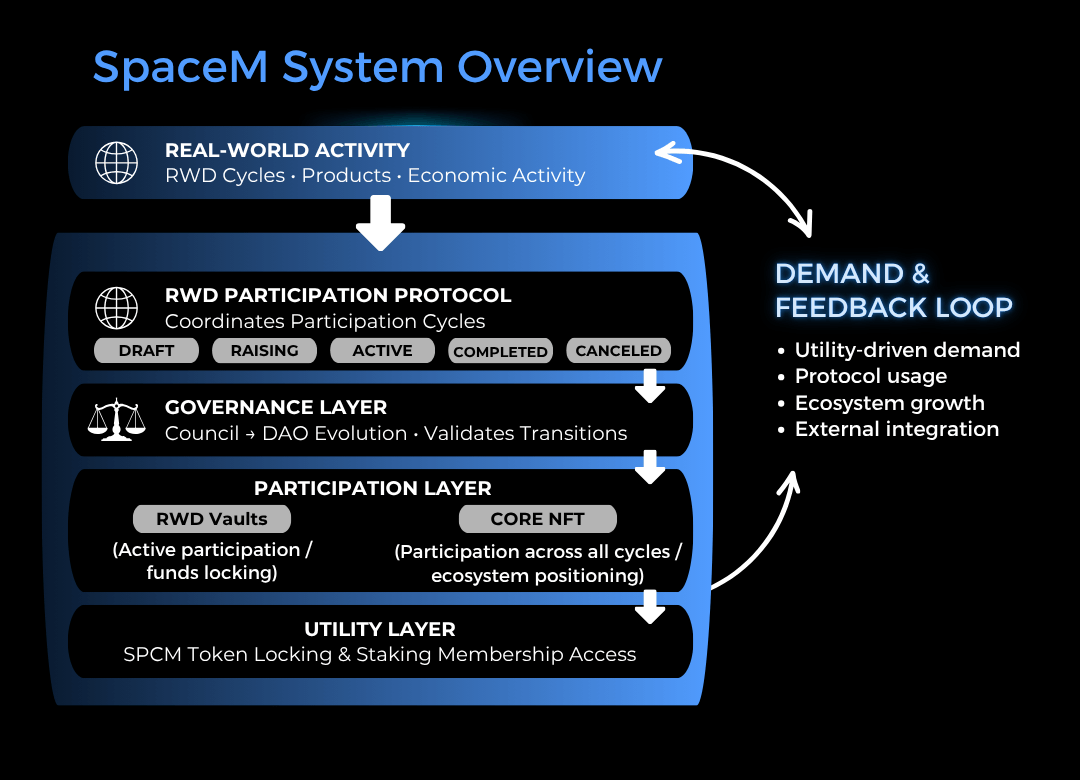
The SpaceM architecture consists of four integrated layers:
The RWD layer coordinates Participation Cycles through deterministic smart contract logic.

Each Participation Cycle progresses through a predefined lifecycle:

Draft → Raising → Active → Completed → Cancelled
State transitions are unidirectional and condition-validated. Governance confirms transitions, but smart contracts enforce structural integrity.

This separation of coordination and ownership defines the protocol’s foundation.

As the ecosystem evolves, this architecture is designed to extend beyond internal coordination toward broader integration with external systems and infrastructure layers.
Diagram 1: System Overview

4. RWD Participation Protocol Framework

4.1 Conceptual Definition

RWD Participation Protocol is a blockchain-native coordination layer that enables structured engagement with real-world economic activity without issuing equity, debt, or asset-backed tokens.

Participants engage in lifecycle-governed cycles, subject to lock requirements and proportional distribution mechanics.

Real-world participation may be coordinated through a combination of internal ecosystem initiatives and integration with external partners and operators.

4.2 Lifecycle State Machine

Each Participation Cycle includes:

Draft
Parameters defined; governance review pending.

Raising
Contribution window active; SPCM lock required.

Active
Cycle executing; no new participants; locks remain immobilized.

Completed
Cycle concluded; ecosystem distributions claimable; locks released.

Cancelled
Cycle terminated; participant contributions returned; locks released.
State transitions cannot be bypassed or reversed.

4.3 Deterministic Enforcement

The state machine enforces: Participation is rule-based rather than discretionary.

5. Participation Mechanics

To engage in a Participation Cycle:

5.1 Lock Function Abstraction

The lock requirement is abstracted as:
L = f(P)

Where:
L = Required SPCM lock
P = Participation amount

The function may include non-linear scaling parameters governed within defined bounds.

Locking serves to:

5.2 Reward Distribution Formula

The state machine enforces: Rewards are distributed proportionally:
Rᵢ = (Pᵢ / Pₜ) × Rₜ

Where:
Rᵢ = Ecosystem distribution for participant i
Pᵢ = Individual participation
Pₜ = Total cycle participation
Rₜ = Total distribution pool for the cycle

The protocol coordinates distribution but does not guarantee performance outcomes.

Over time, the same participation mechanics may extend to cycles involving external projects, partners, and economic networks integrated through the protocol.

6. CORE NFT Framework

20,000 CORE NFTs were introduced to support the bootstrapping phase.

CORE NFTs:
Daily emission is distributed equally among active minted CORE NFTs.

7. Token Economics

7.1 Initial Mint

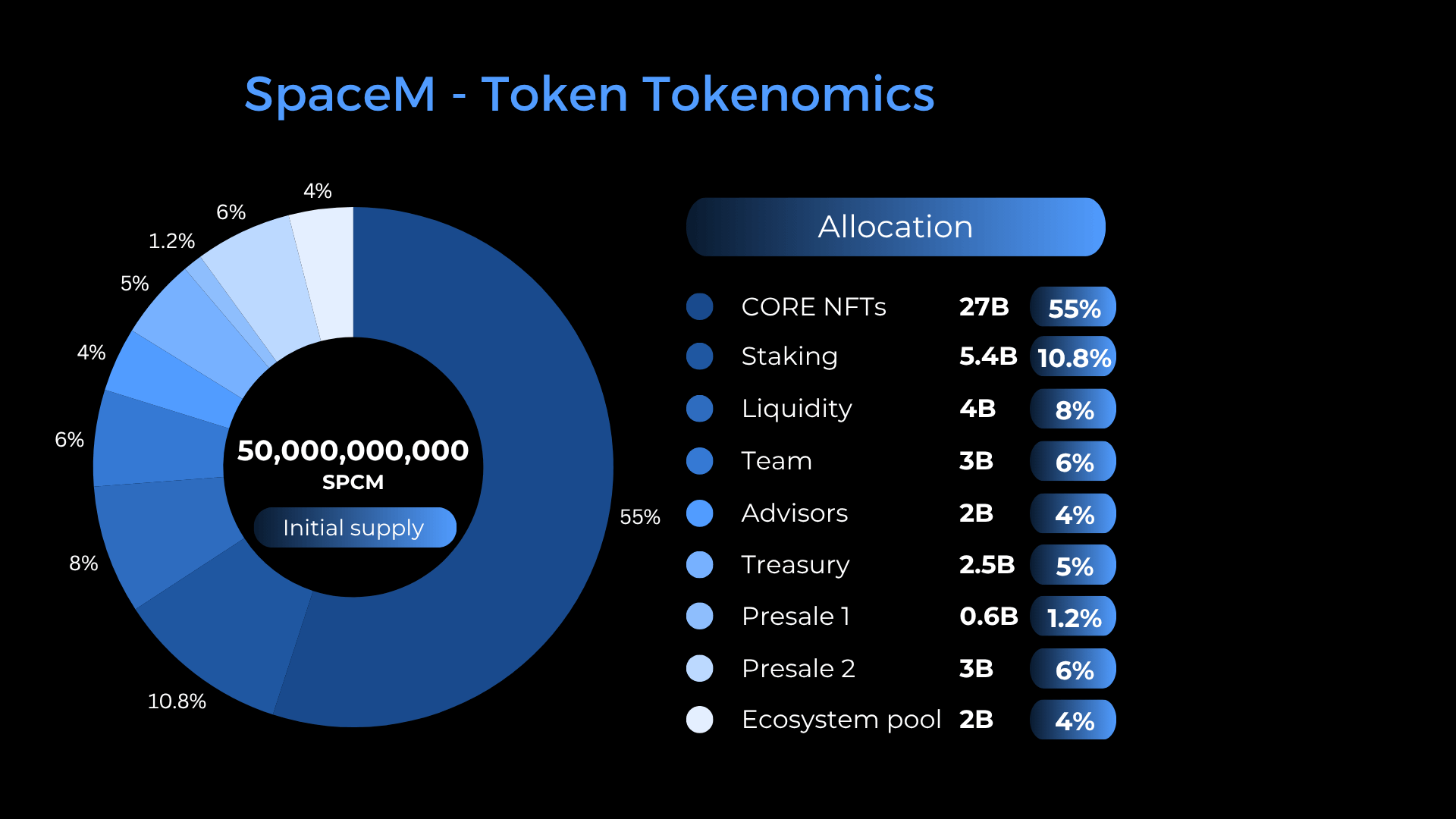
50,000,000,000 SPCM were minted at deployment.

No mint function exists beyond this initial supply.

Supply can only remain constant or decrease.

7.2 Allocation

CORE NFTs — 27.5B (55%)
Staking — 5.4B (10.8%)
Liquidity — 4B (8%)
Team — 3B (6%)
Advisors — 2B (4%)
Treasury — 2.5B (5%)
PreSale 1 — 0.6B (1.2%)
PreSale 2 — 3B (6%)
Ecosystem Pool — 2B (4%)

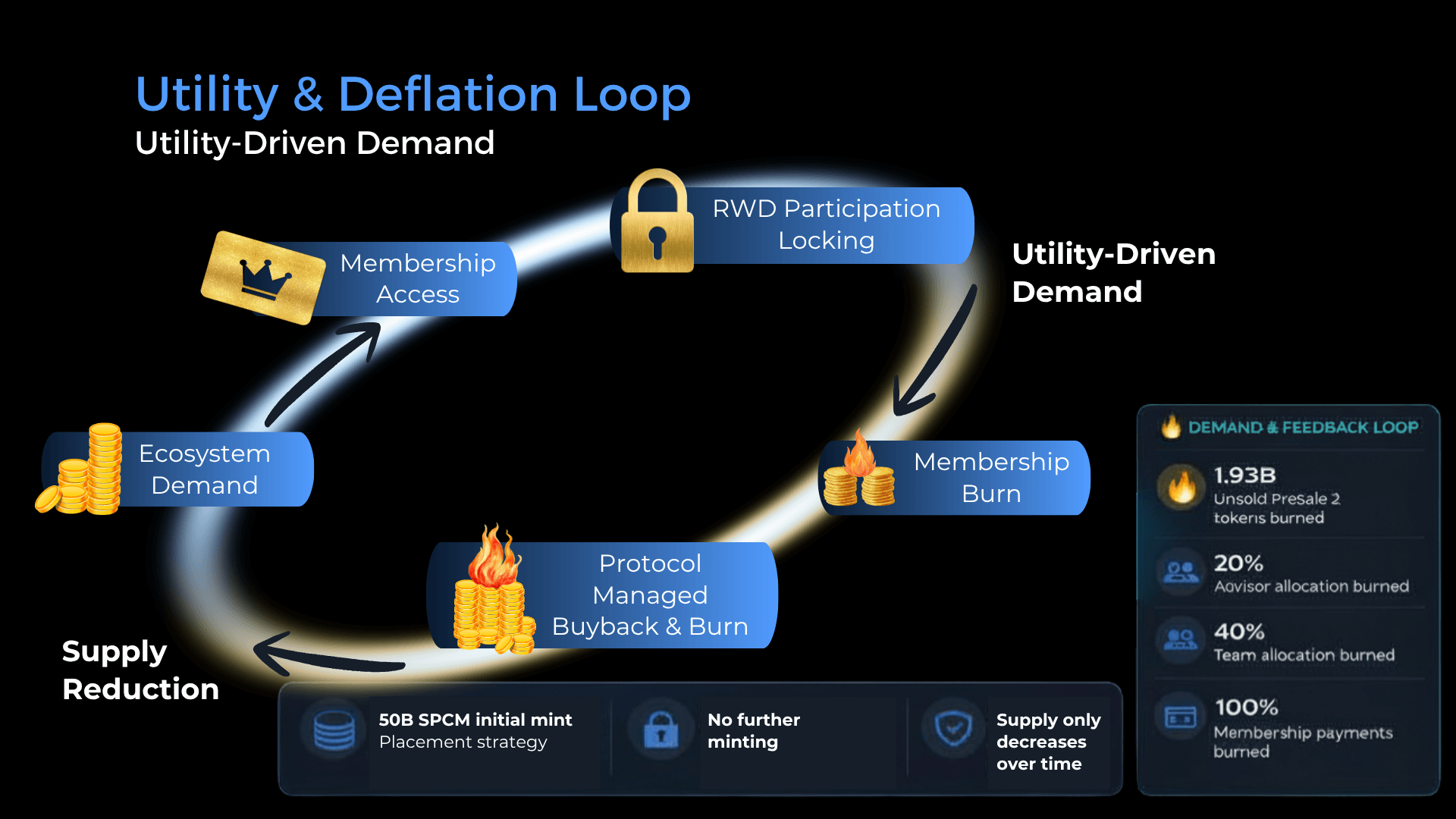
7.3 Permanent Burns

All burn transactions are publicly verifiable on-chain.
Diagram 2 – Token Economics

8. Emission & Vesting Structure

8.1 Bootstrapping Emission (Until 09 May 2029)

Daily Unlock:
12,000,000 SPCM → CORE NFTs
1,500,000 SPCM → Staking
1,500,000 SPCM → Ecosystem Development Reserve

Total Daily Unlock: 15,000,000 SPCM

Emission per CORE NFT:
Eᵢ = Eₜ / Nₐ

At full mint (20,000 NFTs):
600 SPCM per NFT per day

Emission ceases permanently on 09 May 2029.

No governance body can extend, renew, or reintroduce scheduled emissions without deploying a new token contract.

8.2 Vesting Overview

PreSale 1: 10% TGE; 12-month linear vesting
PreSale 2: 20% TGE; 12-month linear vesting
Team: 3-year vesting (40% burned)
Advisors: 3-year vesting (20% burned)
Treasury: 5-year release
CORE: 5-year daily unlock

9. Staking Framework

Staking durations:
3 months
6 months
1 year
2 years
3 years

Longer lock durations unlock greater participation weight within the designated staking supply.

Staking allocations are drawn exclusively from pre-minted, governance-designated supply. No new inflation is introduced. Staking locks reduce effective circulating supply and deepen long-term ecosystem alignment. Staking does not constitute a deposit, investment product, or yield-bearing financial instrument, and does not create entitlement to financial returns.

10. Membership Burn Mechanism

Membership within the SpaceM ecosystem requires SPCM payment.

100% of SPCM used for membership payments are permanently burned.

This links ecosystem usage directly to supply reduction.

11. Protocol Supply Management Policy

A governance-defined portion of ecosystem operational surplus is periodically directed toward open-market acquisition and permanent removal of SPCM from circulation. This supply management mechanism strengthens long-term protocol sustainability by reducing available supply over time. It does not create legal entitlement, revenue-sharing rights, or financial return for token holders.

12. Post-Emission Economic Model

After 09 May 2029: Demand drivers include: Supply reduction continues through: The protocol transitions from emission-supported growth to utility-driven equilibrium, marking a structural shift from supply expansion toward demand-driven optimization.

Post-2029 sustainability relies on participation demand rather than inflation incentives. Participation demand is structurally linked to Vault activation frequency, ecosystem service expansion, and governance utility. As new Vault cycles and ecosystem integrations scale, participation locking becomes usage-driven rather than emission-driven. The protocol’s design assumes growth through utility expansion rather than token issuance.

Over time, demand may also emerge from external systems integrating the protocol as infrastructure, extending participation beyond the native ecosystem.
Diagram 3: Utility & Deflation Loop

13. Governance Model

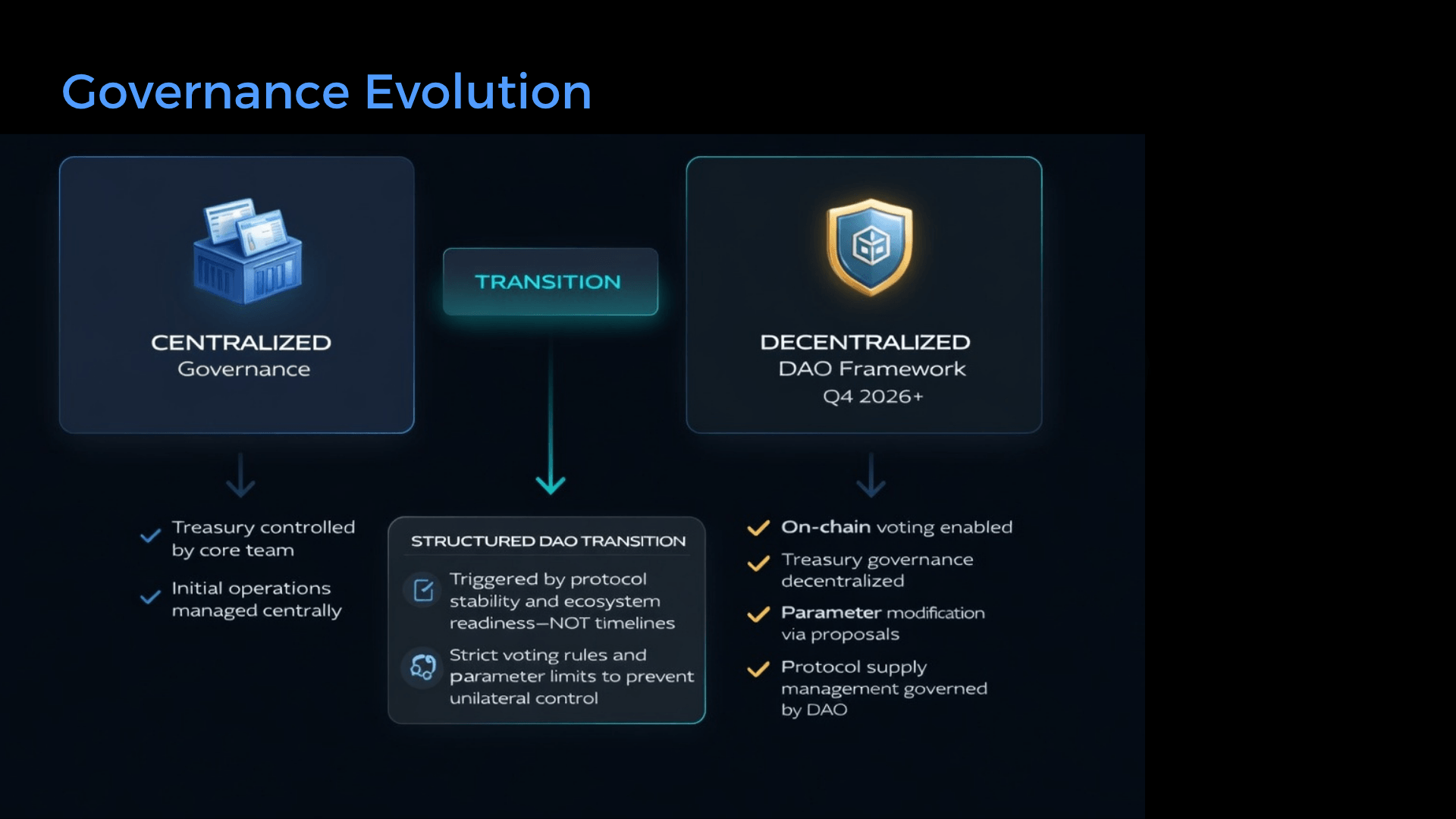
Phase I — Hybrid Governance

A council confirms lifecycle transitions within bounded smart contract constraints.

Council authority:
Council cannot mint tokens or withdraw participant contributions.

Phase II — DAO Governance

Upon activation of the DAO framework (planned for Q4 2026 or later) and potential deployment of a token-native settlement layer: The transition to DAO governance is contingent on demonstrated protocol stability and ecosystem readiness rather than predetermined timelines alone.

Governance authority remains bounded by protocol invariants. Governance power is further constrained by structural voting rules and parameter limits designed to prevent unilateral control over supply, lifecycle integrity, or treasury allocation.

As the ecosystem evolves, governance mechanisms may further align with the development of a dedicated settlement or blockchain layer, enabling tighter integration between protocol execution and governance.
Diagram 4: Governance Evolution

14. RWD vs RWA

RWA tokenizes ownership claims in real-world assets.

RWD digitizes participation without transferring ownership.

RWA:
RWD: RWA introduces: RWD operates without asset custody, balance-sheet tokenization, or fixed-yield commitments.

RWA digitizes assets.
RWD digitizes participation.

15. Security Architecture

Security within SpaceM is embedded at the architectural level. It extends beyond contract audits and operational safeguards into supply immutability, lifecycle constraints, lock enforcement, and bounded governance authority.

The protocol is designed to reduce discretionary risk through rule-bound execution rather than centralized control.

15.2 Lifecycle Constraint Enforcement

Participation cycles operate under predefined state constraints. Governance may confirm transitions, but cannot override structural rules or reconfigure lifecycle mechanics once activated.
Participant contributions and locked tokens remain governed by contract-defined conditions.

15.3 Lock Integrity

Tokens subject to participation or staking locks remain non-transferable for the duration of the lock period.
Lock conditions cannot be bypassed through administrative or governance intervention. Asset mobility is strictly bound to lifecycle completion or cancellation rules.

15.4 Bounded Governance Authority

Governance authority is constrained by protocol logic.

Neither the Council nor the DAO can:
Governance may adjust bounded parameters but cannot compromise structural integrity.

15.5 Economic Predictability

Upon activation of the DAO framework (planned for Q4 2026 or later) and potential deployment of a token-native settlement layer: Emission is time-bound and non-extendable.
Burn mechanisms are rule-based.
Lock requirements operate within defined limits.
Security in SpaceM is structural before it is operational.
It prioritizes enforceability over discretion and transparency over trust.

16. Ecosystem Infrastructure & Roadmap

SpaceM is structured as a layered participation ecosystem in which protocol infrastructure, real-world coordination, product integration, and governance evolution develop in deliberate stages.

The architecture follows a clear progression:
Foundation → Activation → Expansion → Maturity

At its core, SpaceM aligns long-term collaborators through the CORE framework, activates real-world participation via the RWD protocol, expands utility through applied products, and gradually transitions governance toward decentralized structures.

This section outlines the current development status and the roadmap toward full protocol maturity.

16.1 CORE Participation Layer – Highest Collaboration Tier

The CORE NFT represents the highest collaboration tier within the SpaceM ecosystem.

Holding a CORE NFT signifies long-term alignment with protocol development, product expansion, governance evolution, and ecosystem-wide growth. CORE holders occupy the primary participatory tier across all major layers of SpaceM and serve as foundational collaborators in the protocol’s evolution.

CORE functions as the structural anchor of the ecosystem.

This role extends across six integrated dimensions:

16.1.1 Integrated Participation Across RWD Vault Projects

With the public launch of the RWD Participation Protocol planned for May 2026, CORE NFT holders operate at the highest collaboration tier across all RWD Vault cycles.

CORE holders:
• Receive highest positioning in Vault activations
• Participate across all Council-vetted real-world participation cycles

While RWD Vaults require SPCM token locking as part of the participation mechanism, a CORE NFT may serve as a substitute for the $SPCM lock requirement, should the holder elect to use it. This mechanism preserves alignment while reducing friction for long-term collaborators.

The initial Vaults activated in May 2026 will consist of pilot projects confirmed by the Council to validate operational mechanics before broader scaling. CORE holders form the highest eligibility tier within this framework.

16.1.2 Ecosystem-Wide Participation & Performance Alignment

Beyond individual Vault cycles, CORE NFT holders are eligible participants in ecosystem-level programs linked to broader economic activity within SpaceM.

As the ecosystem expands across:
Governance-approved programs may establish structured ecosystem participation frameworks accessible to CORE NFT holders, reflecting the breadth of economic activity coordinated through the protocol. Any such programs are subject to governance approval and defined operational parameters. CORE NFT holding does not create entitlement to revenue, dividends, profit participation, or financial returns from SpaceLabs or any associated entity. These programs represent structured ecosystem access — not financial instruments.

CORE NFT participation reflects structured collaboration — not corporate ownership.

16.1.3 Partner & Recommendation Program

CORE NFT holders are eligible to participate in the SpaceM Partner Program.

Through this program, CORE holders who actively grow the ecosystem may receive governance-defined ecosystem distributions for introducing new participants, projects, or strategic collaborators into the SpaceM network.

The Partner Program is designed to:
Distribution allocation within this program operates under governance-defined rules and does not create commission-based financial entitlements outside protocol parameters.

16.1.4 Priority Access & Infrastructure Integration

As SpaceM expands its infrastructure layer, CORE holders receive structured early access to ecosystem innovations.

This includes:
CORE therefore acts as the bridge between protocol infrastructure and applied real-world utility.

16.1.5 Governance Role in Ecosystem Direction

Governance evolution follows protocol maturity.

During Q2 and Q3 of 2026, hybrid Council governance remains in place to ensure operational stability during early RWD deployment. DAO activation is planned for Q4 2026 or later, contingent upon protocol performance and ecosystem readiness.

Upon DAO activation, CORE NFT holders form the primary governance layer within the decentralized structure.

Governance participation may include:
CORE holders help shape the future direction of SpaceM through bounded, rule-based governance participation.

16.1.6 Structural Positioning

CORE NFT holders represent the highest collaboration tier within SpaceM.

They:
CORE participation is not passive ownership. It is structured alignment with protocol growth and ecosystem expansion.

As the ecosystem evolves across all phases, CORE NFT holders remain structurally positioned at the highest level of participation, spanning early infrastructure alignment, ecosystem expansion, and long-term protocol maturity.

16.2 CORE NFT Lite – Structured Entry Path

CORE NFT Lite expands accessibility while preserving governance integrity.

Each Lite represents one-tenth (1/10) of a CORE NFT in participation scale.

Lite holders participate proportionally in the bootstrapping distribution mechanism but do not receive governance rights or eligibility for full partnership-level ecosystem programs.

Ten (10) CORE NFT Lites may be combined into one full CORE NFT.

Upon conversion, the holder receives full CORE privileges, including:
This tiered model establishes a structured pathway from entry-level alignment to full ecosystem collaboration.

16.3 RWD Participation Protocol – Development & Activation

The Real-World Participation Protocol is currently in advanced development, with public launch scheduled for May 2026.

The protocol connects blockchain coordination with real-world economic activity through lifecycle-governed Vault cycles. Smart contract logic, lock mechanics, proportional distribution structures, and security invariants are undergoing final implementation and staged validation.

Upon launch:
The activation strategy is phased and maturity-driven. Scaling will follow demonstrated operational stability. Subsequent expansion phases will incorporate external partners and operators, enabling broader real-world integration through the protocol.

16.4 Product Layer – Applied Infrastructure

Parallel to protocol activation, SpaceM expands its applied infrastructure layer to embed real-world utility into the ecosystem.

Together these products form the applied infrastructure layer of SpaceM, embedding real-world utility and generating economic activity that integrates with RWD participation cycles and strengthens long-term ecosystem sustainability.

16.4.1 SpaceLabs Debit Card

The SpaceLabs debit card integrates payment infrastructure with loyalty-based ecosystem logic.

As adoption scales, the SpaceLabs debit card network generates real-world economic activity that may support ecosystem-wide programs and strengthen the operational foundation of the protocol.

The card increases real-world economic activity within SpaceM while reinforcing SPCM utility and participation incentives.

Expansion of the card network forms a key component of Phase II growth.

16.4.2 SpaceM Tangem Cold Wallet

The SpaceM-branded Tangem card provides hardware-level self-custody infrastructure.

It strengthens user security, reduces reliance on centralized custodians, and reinforces trust within the ecosystem.

16.4.3 SpaceM Academy

The SpaceM Academy provides structured Web3 and blockchain education.

CORE holders receive expanded access, while advanced modules are accessible via SPCM.

The Academy improves ecosystem literacy, increases token utility, and enhances long-term community quality.

16.5 Integrated Roadmap

SpaceM progresses through three structured phases, reflecting both technical development and ecosystem maturation, while enabling participation across different stages of adoption, understanding, and scale.
 

Phase I — Infrastructure Foundation (Completed)

Building the Functional Ecosystem

In the first phase, SpaceM establishes the foundational infrastructure required for long-term scalability and participation.

This includes:
During this phase, the ecosystem becomes operational and accessible, allowing participants to engage through functional products already generating utility.

This is the stage where the majority of early participants enter the ecosystem through applied infrastructure and product-level interaction.

Phase II — RWD Activation, Strategic Expansion & Infrastructure Evolution (2026–2028 – ongoing)

Real-World Integration & Network-Based Growth

Phase II marks the transition from a functional ecosystem into active coordination of real-world economic activity.
In parallel, SpaceM begins progressive development of its own blockchain infrastructure, evolving toward a dedicated execution and settlement environment aligned with protocol requirements.

This phase introduces:
This phase establishes SpaceM as a coordination layer connecting digital participation with real-world economic networks, driven by both internal development and external collaboration.

Phase III — Maturity, Open Infrastructure & Global Positioning (2029+)

Post-Emission Equilibrium, Protocol Autonomy & Institutional Positioning

Following the conclusion of deterministic emission on 09 May 2029, SpaceM enters a structurally distinct phase.

At this stage:
With the introduction of a dedicated infrastructure layer, the RWD Participation Protocol evolves beyond internal ecosystem use.

It becomes accessible as a coordination framework that may be integrated by external systems, projects, and economic networks, independent of direct SpaceM partnership structures.
 
This enables:
In this phase, SpaceM transitions from an ecosystem operator into a protocol-level infrastructure provider, supporting participation models across diverse economic environments.

Capital Market Evolution

As the ecosystem reaches institutional maturity, SpaceLabs – corporate entity operating the SpaceM infrastructure – is actively targeting an Initial Public Offering (IPO) or equivalent public market listing. SpaceLabs is building toward the operational, governance, and structural readiness required for this pathway, with the IPO process intended to align with the post-emission phase of the protocol. Any Initial Public Offering would be pursued exclusively at the SpaceLabs corporate entity level and conducted in accordance with applicable regulations at the relevant time. SPCM does not represent equity, ownership, or any claim in SpaceLabs or any associated entity. Token holders have no entitlement, preference, or right arising from any future corporate event of SpaceLabs, including any Initial Public Offering.

Key Structural Advantage

A defining characteristic of the SpaceM model is that meaningful participation is accessible across the full arc of ecosystem development — not reserved for late-stage institutional actors.

The ecosystem is designed so that:
This structure enables a broad range of participants to align with ecosystem growth earlier in its lifecycle, rather than only at the final stage.

16.6 Long-Term Vision

SpaceM evolves deliberately.
It builds:
CORE NFT holders remain the highest collaboration tier throughout this evolution.

The long-term objective is to evolve from a protocol-driven ecosystem into a scalable participation infrastructure layer capable of integrating real-world economic systems, external platforms, and institutional frameworks. This includes potential expansion into dedicated blockchain infrastructure, broader protocol adoption beyond the native ecosystem, and integration across global participation and infrastructure environments.
 
In this way, SpaceM advances from a protocol ecosystem into a broader infrastructure layer for real-world digitalization.

17. Risk Considerations

Participation in the SpaceM ecosystem involves structural, technical, economic, governance, and regulatory considerations. While the protocol is architected to reduce discretionary and inflationary risk, no blockchain-based system is without exposure.

The following categories outline the principal risk dimensions.

17.1 Technical Risk

Smart contracts may contain unforeseen vulnerabilities, integration errors, or implementation flaws.

Risks may arise from:
Although the protocol architecture enforces structural invariants, technical systems remain subject to operational risk inherent in distributed networks.

17.2 Governance Risk

During Phase I, governance authority is partially centralized through a Council model. While bounded by protocol constraints, governance execution remains dependent on responsible operation.

Risks include:
Future DAO governance introduces additional considerations, including voter participation levels and proposal quality.

Governance authority is structurally constrained, but governance quality remains a human variable.

17.3 Economic & Market Risk

SPCM operates within open market environments and is subject to price volatility.

Risks may include:
The protocol does not guarantee preservation of contributed funds or specific allocation outcomes. Participation cycles are subject to real-world performance variability.

Post-2029 sustainability depends on ecosystem demand rather than emission incentives.

17.4 Regulatory Risk

Regulatory interpretation of digital asset frameworks varies by jurisdiction and may evolve over time.

Potential exposures include:
SpaceM is structured to avoid ownership tokenization and securities characteristics; however, regulatory environments remain dynamic.

Participants are responsible for understanding applicable laws within their jurisdictions.

17.5 Participation Concentration Risk

Excessive concentration of SPCM or CORE NFTs among a small number of holders may influence governance dynamics or participation allocation patterns.

While governance remains bounded by protocol rules, concentration risk may affect ecosystem balance.

17.6 Real-World Coordination Risk

The RWD protocol coordinates participation in real-world economic activity.

Risks include:
The protocol coordinates participation mechanics but does not control real-world performance outcomes. Vault activation follows a phased, governance-reviewed onboarding process designed to prioritize operational maturity over rapid expansion.
While governance remains bounded by protocol rules, concentration risk may affect ecosystem balance.

17.7 Infrastructure Expansion Risk

Ecosystem growth through product integrations, payment infrastructure, and Vault expansion introduces execution risk.

Scaling may require:
Expansion is phased and maturity-driven to mitigate overextension.

17.8 Structural Risk Perspective

The SpaceM protocol is architected to reduce inflationary, discretionary, and lifecycle manipulation risks through bounded governance, fixed supply, and deterministic emission termination.

However, structural safeguards do not eliminate technical, market, or regulatory uncertainty.

Participation should be evaluated with full awareness of these considerations.

18. Conclusion

SpaceM is structured as a community-governed Real-World Participation Protocol built on: The system transitions from emission-supported bootstrapping to utility-driven sustainability.

It does not tokenize ownership.
It digitizes participation.


A Technical Appendix providing a detailed structural overview of the RWD Participation Protocol — including the participation lifecycle state machine, lock function abstraction, distribution formula, governance role definitions, and emission mechanics — is available upon request.

19. Glossary

Bootstrapping Emission
The scheduled daily distribution of pre-minted SPCM allocated to CORE NFTs, staking, and the Ecosystem Development Reserve during the bootstrapping phase. The Ecosystem Development Reserve supports protocol growth, community expansion, and ecosystem activation initiatives. Emission permanently concludes on 09 May 2029.

Bootstrapping Phase
The predefined distribution period running from token deployment until 09 May 2029, during which scheduled emissions occur according to deterministic allocation rules.

Bounded Governance
A governance model in which decision-making authority operates within predefined smart contract limits and cannot alter foundational protocol invariants such as fixed supply or emission termination.

Burn
The permanent removal of tokens from circulation by sending them to an unrecoverable blockchain address.

Circulating Supply
The portion of SPCM that is unlocked and not permanently burned or immobilized in staking or participation locks.

CORE NFT
A non-fungible token representing the highest collaboration tier within the SpaceM ecosystem. CORE NFTs participate in bootstrapping emission and provide eligibility for governance participation and ecosystem-level programs. CORE NFTs do not represent ownership, equity, or securities rights.

CORE NFT Lite
A participation-tier NFT representing one-tenth (1/10) of a CORE NFT. Grants proportional participation in bootstrapping emission but does not confer governance eligibility or full ecosystem privileges unless combined into a full CORE NFT.

DAO (Decentralized Autonomous Organization)
A governance structure enabling on-chain voting and decentralized decision-making within protocol-defined boundaries.

Emission
The scheduled release of pre-minted SPCM tokens according to the protocol’s time-bound distribution framework.

Hybrid Governance (Phase I)
An interim governance structure in which a council confirms lifecycle transitions and executes bounded operational functions prior to DAO activation.

Locking
The temporary immobilization of SPCM is required for staking or participation in RWD Vault cycles. Locked tokens cannot be transferred during the defined lock period.

Partner Program
A governance-defined ecosystem framework through which eligible participants may receive ecosystem distributions for facilitating onboarding, project introductions, or network expansion within the SpaceM ecosystem. Distributions operate under governance-defined parameters and do not constitute financial returns or commission-based entitlements.

Participation Cycle
A defined lifecycle within the RWD protocol progressing through the states: Draft → Raising → Active → Completed → Cancelled.

Participation Lock
The SPCM immobilization requirement is tied specifically to engagement in an RWD participation cycle.

Protocol Supply Management
A governance-defined mechanism through which a portion of ecosystem operational surplus is periodically directed toward open-market acquisition and permanent removal of SPCM from circulation, reducing available supply over time. This mechanism does not create any entitlement or financial return for token holders.

RWA (Real-World Asset)
A blockchain model in which ownership or financial claims in real-world assets (such as equity, debt, or property) are tokenized.

RWD (Real-World Digitalization)
The conceptual framework through which real-world economic processes are structured and coordinated using blockchain-based lifecycle logic, without transferring ownership or issuing equity, debt, or asset-backed financial instruments.

RWD Participation Protocol
The smart contract–based implementation of the Real-World Digitalization (RWD) framework within the SpaceM ecosystem. It governs participation cycles, token locking requirements, proportional distribution mechanics, and lifecycle state enforcement under bounded governance constraints.
RWD Vault

A structured participation module within the RWD Participation Protocol representing a defined real-world economic cycle governed by lifecycle constraints, participation parameters, and proportional distribution mechanics.

SPCM (SpaceM World Token)
The participation and coordination token of the SpaceM protocol. SPCM does not represent equity, ownership, debt, dividend rights, or financial instrument claims.

Staking
A lock-based mechanism allowing participants to immobilize SPCM for predefined durations, generating participation weight within the governance-designated staking supply. Allocations are drawn exclusively from pre-minted supply.

Settlement Layer
A blockchain or execution environment (existing or dedicated) used to process, validate, and coordinate protocol activity and governance execution.

Strategic Partner
An external organization, operator, or project integrated into the SpaceM ecosystem to participate in or facilitate RWD participation cycles.

Structural Invariants
Protocol-level conditions that cannot be altered through governance, including fixed supply, emission termination, lifecycle integrity, and lock enforcement.

Token-Native Settlement Layer
A future blockchain architecture (such as a sovereign chain or subnet-based environment) designed to support full DAO governance and expanded settlement capabilities.

The SpaceM Promise

SpaceM is built to connect digital access with real-world opportunity through one structured ecosystem.
Our promise is to create a clearer, more useful, and more connected way to participate in the digital economy.
SpaceLabs Ltd,
Trust Company Complex,
Ajeltake Road,
Ajeltake Island,
Majuro,
MH 96960 Republic of the Marshall Islands.

Company registration number: 126445.
The information provided on this website is not intended to solicit the purchase of any financial products directly from us. Tokenized financial assets are not offered by us or any affiliated entities. These backed tokenized assets have not been registered under the U.S. Securities Act of 1933, nor with any state or U.S. regulatory authority. Accordingly: They cannot be offered, sold, or delivered within the United States to, or for the benefit of, U.S. Persons. They may only be offered or transferred at any time to Non-U.S. Persons. Please note that this website may include promotional or advertising content.

Copyright @ 2025 SpaceM | Privacy policy | Terms and conditions | Cookies